A digital-archival exploration · Generative Anthropology
Beyond the Scapegoat: Roamcult and the search for a digital sacred center
Between 2019 and 2022, a community formed around a note-taking app and called itself a cult. It was unmistakably mimetic — yet it never produced a scapegoat. What did it produce instead?
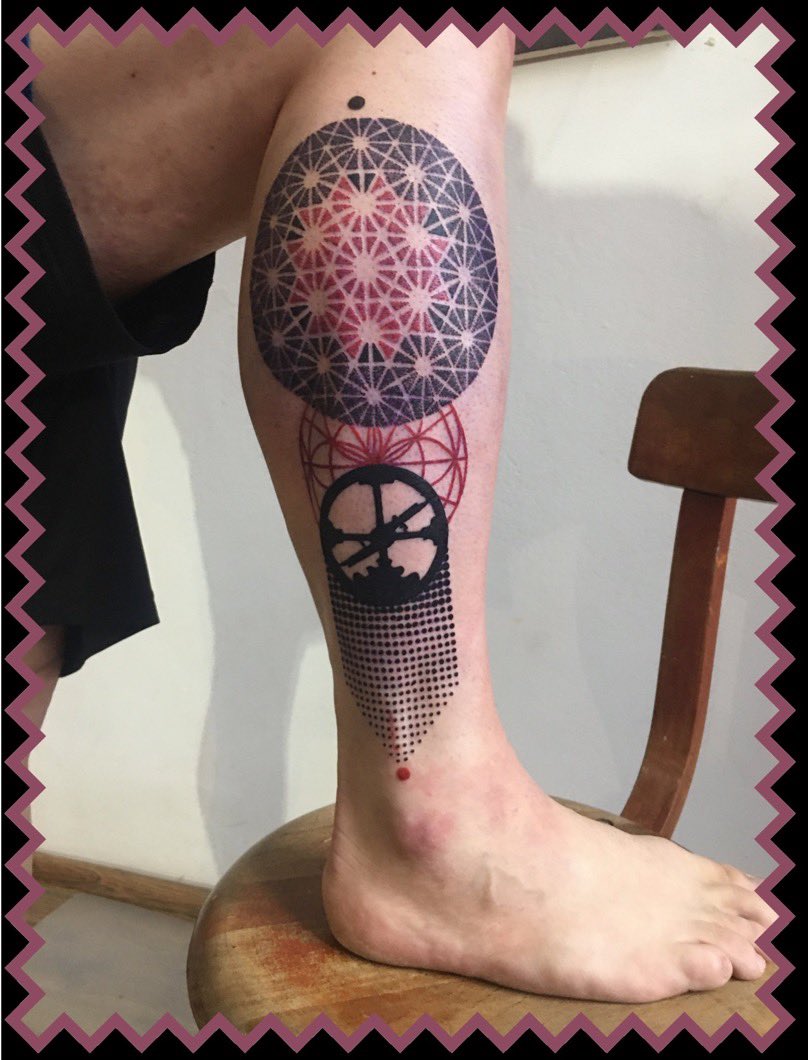
People tattooed a note-taking app's logo onto their bodies. A believer's leg. The founder's own father's arm. By early 2021 the count had reached five — the founder tallying each "#roamcult tattoo" as it appeared. — the most permanent sign a digital scene can leave
Follow the research on Substack ↗

"Roam is truly making the 'second brain' meme not cliché… notes organized in the shape of thoughts… a search bar to your memory. Listen, I'm this close to getting a mariner's astrolabe tattoo. Please, you have to believe me. You can't compare it to Notion."— @abettertake, Jan 2021 · source ↗
Photographs are public posts, reproduced for scholarly commentary with links to source. Faces of non-public individuals may warrant consent or cropping before wider publication.
What began as a user community around Roam Research rapidly took on characteristics its own members recognized as cult-like: fervent testimonials of cognitive transformation, evangelical recruitment, tattoos of the logo, public sharing of personal knowledge graphs, and a tiered [[Believer]] membership that formed an inner circle around the product's development. The intensity peaked as pandemic lockdowns drove social life online. By 2022, the fervor had largely dissipated.
This is a hypothesis-generating account, not a completed ethnography. It draws on public Twitter/X discourse, community traces, and the researcher's own participation during the period of greatest intensity. It asks whether Roamcult can be understood as a case of scenic formation — and whether Eric Gans's originary thinking can clarify what René Girard's scapegoat mechanism alone does not.
The Girardian entry point
Roamcult was clearly mimetic. Participants did not arrive at enthusiasm through isolated evaluation of features; they encountered others' visible desire and were drawn into it. Scrolling Twitter, prospective users saw life-changing testimonials, shared workflows, screenshots of personal graphs. They desired not merely a useful tool but the clarity, belonging, and identity others appeared to have found. Desire spread through contagion.
The gap Girard leaves open
Yet Roamcult did not culminate in sacrificial crisis. The community generated collective energy without being organized by destructive rivalry. Participants outdid one another in helpfulness — tutorials, public thinking, plugin development, zeal. One participant's phrase captures it:
"friendly ambitious nerds"— a Roamcult participant, on the community's competitive generosity
Toward Gans: desire organized around a center
If Girard explains the contagion of desire, Gans may explain how that desire was organized around a shared center. In the originary hypothesis, the group constitutes itself through shared reference to a center of attention that both intensifies and regulates desire. Here, Roam-as-represented functioned as such a center — not simply software, but a shared object of transformation around which participants organized practices, identities, and mutual recognition. The technical substrate (bidirectional links, block references, daily notes, graph structures) was real; but the center was constituted by collective representation: the claim that Roam changed how one thought.
Irony hardening into sincerity
The tongue-in-cheek self-identification as a "cult" may have intensified this scenic formation. The ironic framing licensed forms of fervor that might otherwise have felt excessive — participants could perform zeal while staying in on the joke. But observers could read those performances as earnest, and public signs of devotion fuelled further imitation. What began as irony may have accumulated into sincerity.
A trajectory in scenic terms
The center emerges
Mimetic desire is drawn into a common field of attention organized around Roam-as-represented.
Scenic coherence
Participants orient toward the same center with escalating intensity, held in productive tension by shared signs and recognition.
The charge fades
Obsidian and Logseq draw attention elsewhere; pandemic conditions ease; the company's public energy diminishes. The scene dissipates — without a scapegoat.
Roamcult is offered as a pilot case for digital scenic formation. Platforms make others' desires continuously visible, accelerating contagion but also making scenes fragile: attention gathers quickly around a center, and migrates quickly when the center loses charge.
Questions brought to the conference
— Is "sacred center" the right Generative Anthropology concept for Roam-as-collectively-represented?
— How might one distinguish mimetic contagion from scenic formation using public digital archives?
— What interviews, artifacts, or comparative cases would turn this pilot into a fuller ethnographic project?
